NO HEAT, COLD SNAP CALLS
Furnace repair in Springdale and Northwest Arkansas
No heat, a furnace that quits after two minutes, a house stuck in the mid sixties. We check the gas, the flue and the air first, then find the actual fault.
Chapter 01
A cold house, a clicking burner, a heater stuck at 66
No heat is the call everybody understands. The quieter ones are just as real: a furnace that lights, runs a couple of minutes and quits, a house that never climbs past the mid sixties, a blower that runs with nothing warm behind it. In Springdale and Rogers those calls pile up on the first hard freeze of the year, when every furnace in town gets asked to work at once.
Most of the time it is not the whole furnace failing. It is one small part saying so loudly. A dirty flame sensor that cannot prove the burner is lit. A tired igniter. A filter so loaded with dust the air cannot move. A condensate drain backed up and tripping a safety switch. A thermostat with dead batteries or a loose wire. Each one looks like a dead furnace from the living room, and each one has a different fix.
A customer named Albert Lew wrote this on Stith's own site: “We had problems with our heater, going up higher than 66° in the middle of a cold snap. Ridge came out and immediately saw that it was just a matter of blocked circulation. He fixed it and our heater was up and running in a matter of time.” That is the kind of call this page is about: a cold house, a small cause, and a tech who knew where to look.
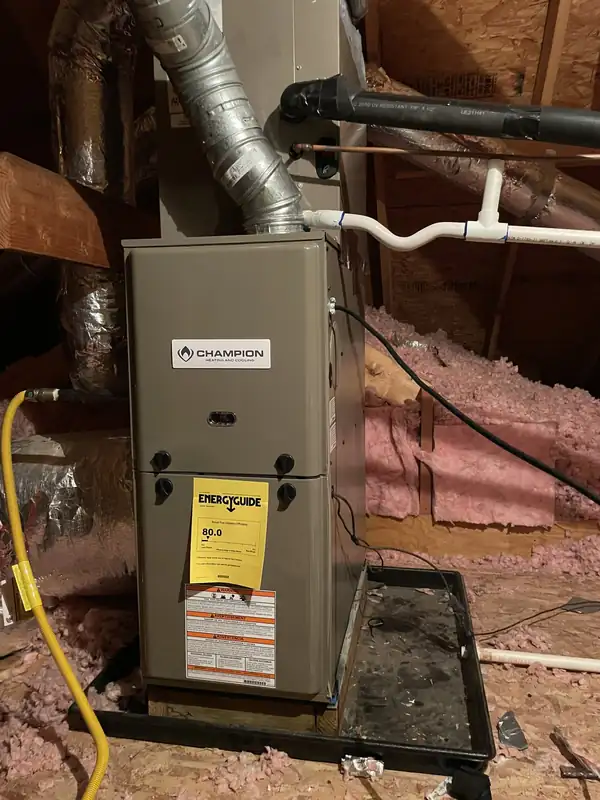
An upright gas furnace installed in an insulated attic
Gas, flue and carbon monoxide get checked before anyone touches the burner
A furnace burns gas and vents the exhaust out through a flue, so the first look is never at the part you think is broken. It is at the gas supply, the flue draft, the heat exchanger and a carbon monoxide reading in the room. If you ever smell gas, leave the house, call from outside, and do not flip a light switch on your way out.
Then comes the real diagnosis, done in order. Does the thermostat call for heat. Does the inducer fan start. Does the igniter glow. Does the flame light and stay lit. Does the blower come on at the right time. Working down that chain finds the fault without guessing, which means you replace the part that was actually bad. Brett Stith, Zach Stith and Ridge Hill run the residential side of the shop on Lowell Road.
Gary Stith, the owner, is a Master Plumber, Pipe Fitter and HVAC/R registrant, so gas piping, flue pipe and the furnace itself stay under one roof instead of being passed between three trades. The company has been fixing heat in Northwest Arkansas since 1965, and the number on the van is still (479) 751-9691.
Chapter 03
The easy fix first, the new furnace only when the numbers say so
Stith's own answer on repair versus replace is plain: if the system is newer and the repair is minor, fixing it often makes sense. If it is old, inefficient or breaking down again and again, replacement may be the better long-term call. Either way, the choice is laid out for you without pressure, and the furnace you have gets a full look before anyone mentions a new one.
Customers keep writing about this. Amanda Lykins said on Google that Ridge “checked everything fully without seeing the age of my machine and automatically tell me I needed a new one when it was an easy fix.” Joshua Thomas, writing on Stith's site, said that instead of an upsell, “Ridge found out it was a simple fix, saving us both Time and Money.” Jen, also on Google, put it in two words: “no upsells!”
When repair is the right answer, it carries Stith's word. The company's own site says all heating, air conditioning and plumbing installation and services are 100% guaranteed. The same shop that fixed it answers the phone if it acts up again, and Leigh and Kathy in the office keep the schedule moving so you are never left wondering what happens next.
Filters, airflow and a fall tune-up that keeps the next call away
Most no-heat calls start with airflow. A filter that has not been changed since summer, a return grille blocked by a couch, a furnace in a crawlspace or attic with insulation packed against it. Clean filters, open returns and clear space around the cabinet head off many of the overheating and short cycling calls that trip a furnace's safety switch.
Stith's own advice is a professional tune-up once a year, with furnaces in the fall and air conditioners in the spring. A tune-up is where a weak igniter or a dirty sensor gets caught on a mild October afternoon instead of a freezing January night. Burners get cleaned, the flue gets inspected, and the safety controls get tested.
If the same furnace needs a second or third repair in one season, that is information too. A cracked heat exchanger or a worn-out blower is a replacement conversation, and the furnace installation page covers how that goes. For the nights when the cold will not wait, Stith runs 24/7 emergency service.
Family-owned since 1965, with HVAC/R Registrant 1056339 and Master Plumbing License MP4210 painted on the vans. Call (479) 751-9691.