Gas piping, done by a licensed hand
Gas line installation and repair in Springdale, Arkansas
New range, new water heater, a furnace moving to a different spot, or a gas smell you can't ignore. Gas piping is licensed plumbing work, and it gets sized, run and tested the right way.
Chapter 01
A gas smell, a new appliance, an old connector
If you smell gas, don't call us first. Get everyone out of the house, leave the lights and switches alone, and call the gas company or 911 from outside. Don't try to find the leak yourself, and don't go back in for anything. Once the house is safe and the gas is shut off, that's when we come in and make the repair. Our emergency line runs 24/7.
Most gas line jobs aren't emergencies. Someone wants a gas range where an electric one used to sit. Someone else is adding a generator. A new water heater or furnace is going in a few feet from the old one, and the existing line doesn't reach. Most of these are straightforward jobs once someone measures the run and checks what the line can carry.
Then there are the old connectors. A flexible appliance connector that's been behind a range or at a water heater for decades can crack, kink or corrode, and nobody looks at it until something smells wrong. They're worth replacing whenever an appliance gets swapped, not left behind. They take minutes to look at, and they're worth replacing before they fail.
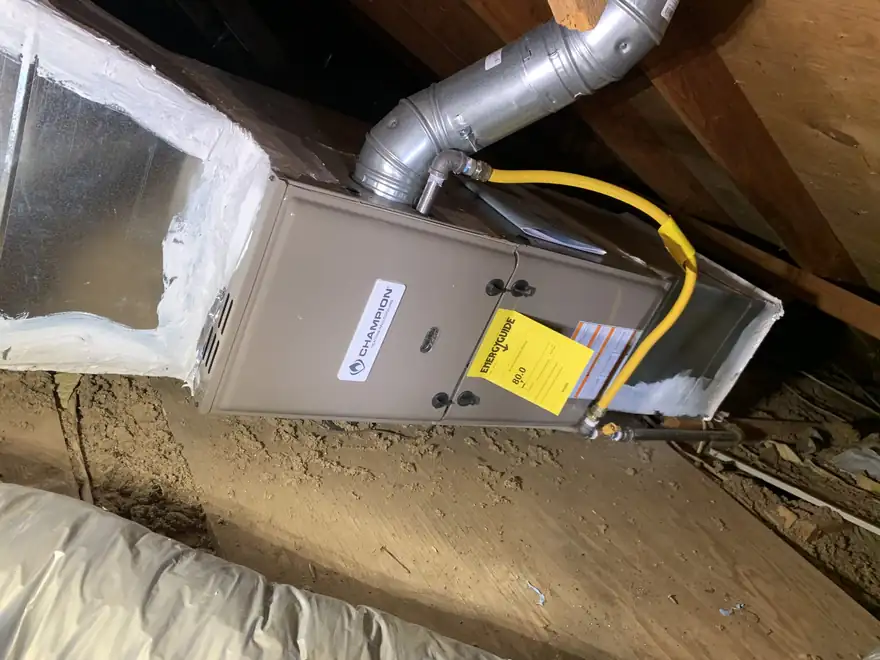
A gas furnace in an attic with its yellow gas supply line and flue connected
Sizing, running and pressure testing the line
A gas line isn't just a pipe from A to B. The pipe has to be sized for every appliance it feeds, at the length it has to travel, so the last burner on the line gets the same gas as the first. Ranges, dryers, water heaters and furnaces each pull a different amount, and the pipe has to carry them all at once. Undersized pipe is how a new range ends up with a weak flame whenever the furnace kicks on.
Once the pipe is routed, we connect the appliance shutoff and the connector, then pressure test the piping before anything gets lit. That's the step that proves the joints hold. Then we light the appliance and watch the flame, because a steady flame tells you the supply is right. We check every fitting, not just the ones that were easy to reach.
You can see the same care in the furnace photo on this page: a yellow gas supply line coming in clean, a shutoff you can reach, and a flue run properly out of an attic. Anyone who opens that attic hatch should be able to see where the gas comes in and how to shut it off. Master Plumber Gary Stith's license, MP4210, stands behind the plumbing work.
Chapter 03
Why gas work stays licensed work
Gas piping is not a weekend project, and it's not the place to save a few hours with a friend who owns a pipe wrench. A small leak at a fitting can sit unnoticed for weeks. Combustion appliances need the right gas, the right venting and a clean burn, and those pieces all have to agree. A slow leak at a fitting doesn't announce itself, which is why testing the line matters more than trusting how it looks.
Put a carbon monoxide alarm on every level of the house, especially near bedrooms, and test it when you change the clocks. Alarms wear out, so check the date stamped on the back. It's the simplest protection against a problem you can't smell or see. If one ever goes off, get outside first and sort out the cause second.
When the work is finished, we'll show you where the shutoffs are and what each one controls. Everything we install and service is 100% guaranteed, and the same family that's been fixing Northwest Arkansas plumbing since 1965 will answer the phone if something doesn't feel right. If you've got an old line nobody's looked at, we're glad to take a look.
Master Plumbing License MP4210, family-owned since 1965, and 24/7 emergency service. Call (479) 751-9691.