Trench log
Sewer line repair in Springdale and Northwest Arkansas
A backup in the lowest drain is the line telling you it has broken somewhere. We run a camera to see the break, then repair or replace exactly what the camera shows.
Chapter 01
Signs the main sewer line has let go
The lowest drain in the house gives it away first. A basement floor drain that bubbles, or a ground-floor tub that fills when the washing machine runs, usually means the main line is blocked or broken somewhere between the house and the street. One slow sink is a fixture problem. Every drain slow at once is a line problem.
Outside, look at the yard. A soggy patch that stays wet in dry weather, a strip of grass that grows greener than the rest, or a low spot opening up over the line can mean a break is letting sewage out. A sewage smell near the foundation or in a floor drain points the same direction.
Roots, a collapsed section and a sagging belly in the pipe can all cause these signs, and from the surface they look identical. Guessing is how people end up with a dug-up yard that did not need it, or a cleared line that fails again in a month.
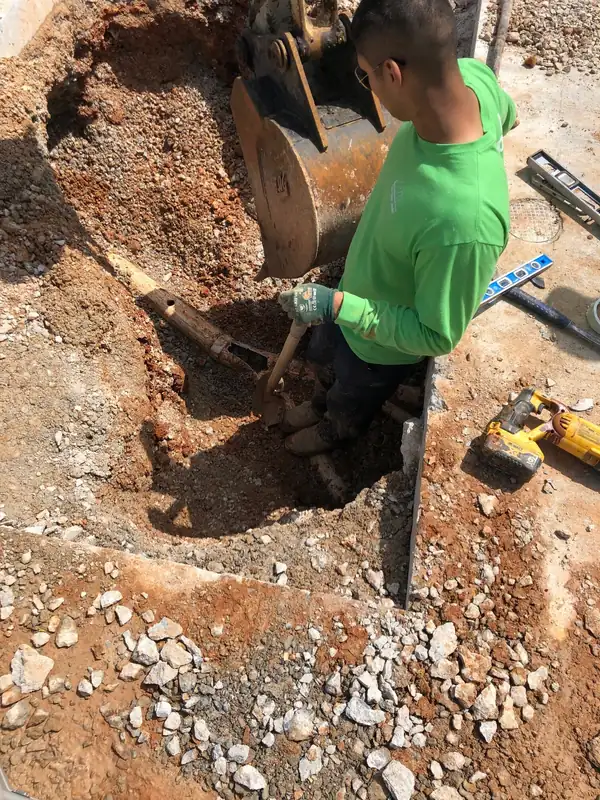
A Stith crew member working in an excavated trench to reach a buried sewer line
Camera first, shovel second
Before anyone digs, we run a camera down the line. It shows the break, the root mass or the sagging section on a screen, and it shows how far from the house it sits. Then you and the plumber are looking at the same picture, and the decision is about the pipe in front of you, not a guess.
That camera step also keeps the dig small. Knowing exactly where the break sits means the trench starts in the right place and ends where the damage ends, instead of opening up the whole yard to find a problem that could have been a few feet long.
Not every camera trip ends in a dig. Sometimes it finds a clog that a cable and a proper clearing will fix, and that is a good day for everybody. Our drain crews and our sewer crews work from the same shop at 2231 N Lowell Road in Springdale, so your call does not get passed around.
Chapter 03
Repair a section or replace the run
A single cracked joint or one crushed section can often be cut out and replaced without touching the rest of the line. A pipe that is root-riddled and sagging from end to end is a different decision, and we will say so plainly, with the camera footage as the reason and not a sales pitch.
The photo on this page is one of our own: a Stith crew member working in the trench to reach a buried line. That is the real work. Digging down to the pipe, cutting out the bad section and joining new pipe to good. It is slow, muddy and exact, and it has to be done right because it gets buried.
Gary Stith holds Master Plumbing License MP4210, and larger or commercial lines go to our Commercial Plumbing Division. Residential lines in Springdale, Fayetteville, Rogers and the towns around them get the same plain approach: see the problem, show the homeowner, fix the pipe.
After the repair, the yard and the next few decades
Once the new pipe is in and water runs the way it should, the trench gets backfilled. That is part of the job, not an afterthought. A line that settles is a line that sags, so the bedding under the pipe and the fill around it matter nearly as much as the pipe itself.
Older neighborhoods across Springdale, Rogers and Fayetteville often have clay or cast iron lines that are as old as the houses. Those pipes did their work for a long time. When one finally goes, replacing the failed section now is usually easier than waiting for the next backup to make the decision for you.
Keeping the line healthy is simple. Keep grease out of the kitchen drain, skip the flushable wipes, and plant trees with aggressive roots well away from the line. If a drain starts to slow again, call the office Monday through Saturday, 7 AM to 7 PM, at (479) 751-9691.
Master Plumbing License MP4210. Family-owned since 1965. Call (479) 751-9691.