WATER WHERE IT SHOULDN'T BE
Leak and Slab Leak Detection in Springdale, Arkansas
Leaks found inside walls, under slabs and underground with detection equipment, then repaired with as little opening up as the job allows.
Chapter 01
A water bill that climbed and nothing is dripping
The expensive leaks are the quiet ones. A faucet drip you can hear, and you can fix it. A line leaking inside a wall or under a slab just shows up as a water bill that jumped, a meter that keeps turning with every fixture off, or a faint hiss at night when the house is silent and everyone has gone to bed.
Other signs are physical. A warm spot on a floor over a slab can mean a hot water line is leaking beneath it. Damp drywall, a baseboard that's swelling, a musty cabinet under a sink, or a patch of yard that stays soggy when it hasn't rained all point at water going somewhere it shouldn't.
Water travels along framing, pipes and the top of a slab before it ever shows itself, so the wet spot you can see is often a few feet from the actual break. Guessing means cutting open walls and floors that never needed cutting. Finding the leak first is how you avoid that, and it's what the rest of this page is about.
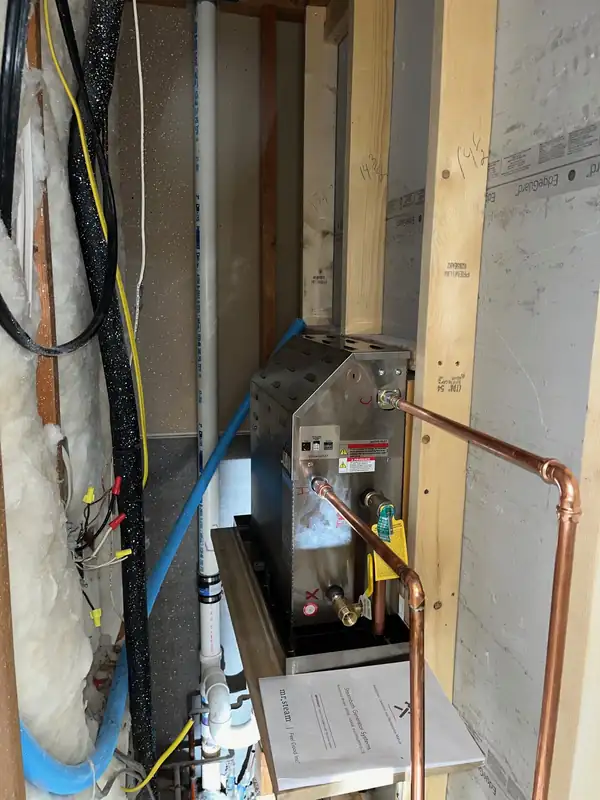
New copper water lines run neatly through an open wall cavity
Isolating the line before anyone opens a wall
We start with the house itself. Everything that uses water gets shut off, and we watch the meter. If it still moves, there's a leak on the supply side. From there we split the system up: hot from cold, one part of the house from another, the line coming into the house from the lines inside it. Each step narrows down where the water is going.
Then comes the detection equipment. It lets us pinpoint a leak inside a wall, under a slab or out in the yard before we pick up a tool to open anything. The tools pick up the sound and the signature of escaping water. Stith holds Master Plumbing License MP4210, and owner Gary Stith is a Master Plumber, so the diagnosis comes from licensed plumbers, not a guess with a hammer.
Chapter 03
Repairing it with as little opening up as the job allows
Once we know where the break is, the repair can be small. A pinhole in a copper line inside a wall usually means one small opening, a cut-out and a new section of pipe. Our own job photos show copper water lines run cleanly through an open wall cavity, and that's the kind of work we want to leave behind in your house.
Under a slab it's a different decision. You can break the slab to reach one spot, or you can re-route the line through the attic or the walls and abandon the old run. Neither one is right for every house. We lay out both, and tell you what each one means for your floors and your walls, before anything starts.
Not every plumbing problem is a clean one. Shelby Albarran wrote on Google that she called with "a unique problem left by another plumber" and that Stith was able to "send a tech out the next day, get us an estimate, and complete the repair the following day." That's the pace and the straight answers we aim for on a hard one.
Checking the rest of the system, and knowing your shutoff
A leak is rarely a one-off. When one fitting or length of pipe has failed, we check the rest of the system around it: the connections at the water heater, the supply lines to the fixtures, the shutoff valves, the pressure coming into the house. Finding a second weak spot now beats finding it on a Saturday night with water on the floor.
Do one thing today. Find your main water shutoff and make sure it turns. If a pipe lets go, closing that valve stops the damage while you pick up the phone. In Springdale houses it can be in a meter box near the street, the garage, a utility room or a crawlspace. Call (479) 751-9691. Emergency service is available 24/7.
Master Plumber on staff, Master Plumbing License MP4210, and emergency service 24/7. Call (479) 751-9691.