Whole-House Water Filtration in Northwest Arkansas
A softener and a whole-house filter solve different problems, and plenty of Northwest Arkansas homes end up needing both.
October 1, 2026 · 4 min read
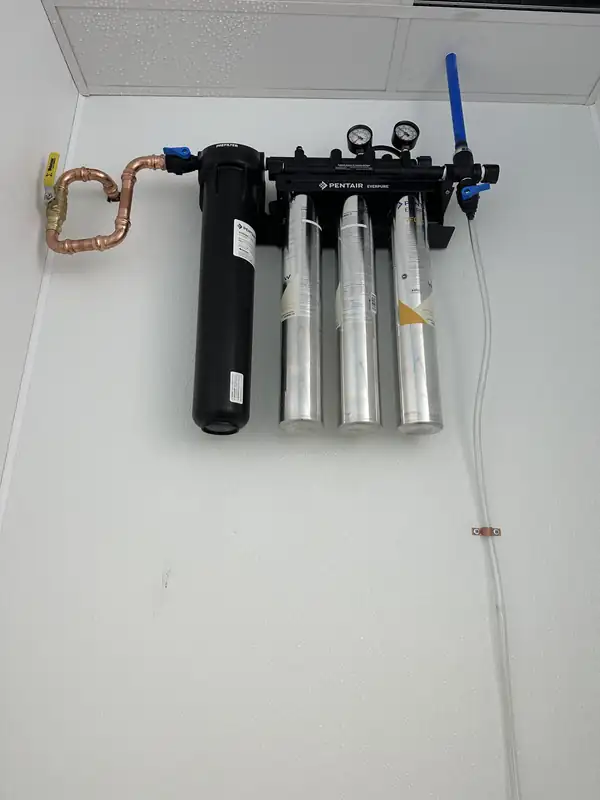
Most people don't think about their water until something shows up. White crust around the faucets. A dishwasher that leaves spots on every glass. A glass of water that tastes like a swimming pool. Skin that feels tight after a shower. These aren't random annoyances. They usually trace back to what's in the water coming into your house, and there are real fixes for them. The tricky part is knowing which fix matches which problem.
Safe water and good water aren't the same thing
City water is treated to be safe to drink. That treatment often includes a disinfectant, and some people can taste or smell it. Treated water can also still carry dissolved minerals and fine sediment. Safe doesn't mean there's nothing in it. It means the water meets the standards it's held to before it reaches you.
Northwest Arkansas sits in the Ozarks, where limestone is common, and water that moves through that kind of rock tends to pick up minerals. Those minerals are what cause scale, the chalky buildup you see on showerheads and the inside of kettles. If you have a private well, your water has its own story, and the only way to know what's in it is to test it.
Hard water, taste and sediment are three different problems
It helps to sort what you're seeing into groups, because each group has a different cure.
- Scale and spotting: chalky crust on fixtures, cloudy glassware, stiff laundry, soap that doesn't lather well. This is a mineral problem, and a water softener is built to deal with it.
- Taste and smell: water that smells or tastes like chlorine, or has a flat, off flavor. This is a filtration problem, and a carbon-style whole-house filter is the usual tool.
- Sediment and cloudiness: grit in the aerator, fine particles in a glass left to sit, clogged fixtures. This is also a filtration problem, handled by a sediment filter at the point where water enters the house.
Softener, whole-house filter, or both
A softener swaps the minerals that cause scale for something that doesn't build up on surfaces. It does a great job on scale. It isn't a filter, though, so it won't take out a chlorine taste or catch grit on its own.
A whole-house filter works the other way around. It cleans up taste, smell and particles for every tap in the house, but it doesn't do much about the minerals that make scale. That's why people sometimes install one system and feel only half satisfied. They fixed the taste and still have spots on the glasses, or they fixed the spots and still smell chlorine in the shower.
Many homes end up with both, with the filter and softener working in sequence. A smaller under-sink filter at the kitchen tap is a different thing again. It improves drinking water at one faucet, and that's all it does. It won't protect the water heater or the shower.
What hard water does to your plumbing
Scale doesn't only look bad. Inside a tank water heater, minerals settle on the bottom and cake onto the heating surfaces, which makes the heater work harder and can shorten its life. Inside a tankless unit, scale coats the heat exchanger and cuts performance until it's cleaned. Faucet aerators and showerheads clog. Dishwashers and washing machines collect buildup in places you can't see.
That's the practical case for treating water at the point where it enters the house. You're protecting the equipment that's hardest and most expensive to replace, not just fixing a taste.
How to decide what your house needs
Start with what bothers you, and be specific. Write down what you notice and where. Then get your water tested, because guessing leads to buying the wrong system. A test tells you what's actually there, and a good plumber will match the equipment to the results instead of selling you the biggest package.
A few questions are worth asking anyone who quotes you work:
- What exactly will this system remove, and what won't it touch?
- What maintenance does it need, and how often?
- Where will it be installed, and does it need a drain or an electrical outlet nearby?
- Will it work with my existing water heater and plumbing?
Talk to a plumber who lives here
Stith Plumbing & HVAC has been serving Northwest Arkansas homes since 1965, and water softeners are part of our plumbing work. If you're seeing scale, tasting chlorine, or just wondering what your water is doing to your pipes and water heater, call (479) 751-9691. We'll look at what you're dealing with and explain your options in plain language.
Stith Plumbing & HVAC, (479) 751-9691
Call (479) 751-9691More articles
Why Your Hot Water Runs Out Too Fast
Hot water that disappears early almost always has a cause you can name, and a few of them you can check before you call anyone.
Is a Smart Thermostat Worth It?
A smart thermostat is a good upgrade for the right system, as long as you know what it can and can't do.