Why Your Hot Water Runs Out Too Fast
Hot water that disappears early almost always has a cause you can name, and a few of them you can check before you call anyone.
October 1, 2026 · 4 min read
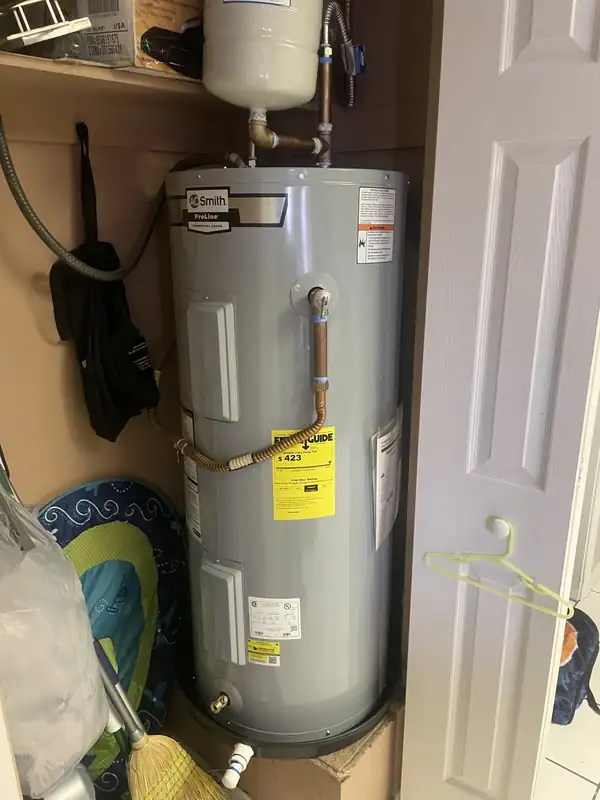
The shower starts out fine. Ten minutes later it's lukewarm, and by the time the next person steps in, it's cold. If that sounds like your house, you're not stuck with it. Hot water that runs out early almost always has a cause you can name, and a few of those causes you can check yourself before you pick up the phone. Here's how we'd think it through, in the order we'd think it through.
Start with size and habits
A tank water heater holds a fixed amount of hot water. When it's gone, you wait while the tank heats a fresh batch. If your household has grown, if a teenager now takes long showers, or if you added a big soaking tub, the tank you bought years ago may simply be too small for the way you live now.
Think about when the hot water runs out. If it's always the third shower of the morning, or right after the dishwasher and the washing machine finish together, that points to a capacity problem and not a broken part. Spreading out demand helps, and it's free. Run laundry at a different time of day and give the tank a chance to catch up. If you've done that and the tank still can't keep pace, a larger tank or a different style of heater may be the real fix.
Sediment: the slow thief at the bottom of the tank
Tap water carries dissolved minerals. Inside a tank, those minerals settle out and pile up on the bottom as sediment. On a gas heater, that layer sits between the burner and the water, so the burner works harder and the tank holds less usable hot water. On an electric heater, the lower heating element can get buried in sediment and burn out.
The signs are easy to spot once you know them. You might hear popping or rumbling when the heater runs. The water might look cloudy or rusty when you first open the hot tap. The heater might take longer than it used to to recover. Flushing a tank can clear light buildup, and it's a normal part of keeping any tank healthy. A tank that's been ignored for many years can have sediment packed hard, and a flush won't shift it. At that point the question is whether the tank has life left.
Parts that fail and cause short hot water
Sometimes the tank is the right size and clean, and a single part is letting you down. These are the usual suspects:
- A broken dip tube. Cold water enters the tank through a tube that runs to the bottom. If that tube cracks, cold water mixes in near the top, right where your hot water leaves, and everything turns lukewarm fast.
- A failed lower element on an electric heater. Most electric tanks have two elements. If the lower one quits, you get a short burst of hot water from the top of the tank and then nothing.
- A thermostat that reads wrong. On an electric heater, a bad thermostat can shut the heat off too early or never ask for enough of it.
- Gas burner or gas control trouble. A dirty burner, a weak pilot or a tired gas control can keep the heater from reaching full temperature or make it reheat slowly.
- Cold water leaking into the hot side. A worn shower valve or faucet cartridge can let cold water cross over, so the heater gets blamed for something it isn't doing.
What you can check yourself
You don't need tools for most of this. A few minutes of looking can save you a service call, or at least give the technician a better starting point.
- Look at the temperature setting. Someone may have turned it down to save energy, or a child may have bumped the dial.
- On an electric heater, check the breaker panel. A tripped breaker means no heat at all.
- On a gas heater, see whether the pilot or ignition is working. If you ever smell gas, leave the house and call for help from outside. Don't try to relight anything.
- Notice whether the problem happens at every fixture or only one. Trouble at one shower points to that valve, not the heater.
- Look around the base of the tank for puddles, rust streaks or dampness. Any leak from the tank itself is a reason to call soon.
Tankless heaters have limits too
A tankless heater doesn't run out the way a tank does, but it has a flow limit. Run a shower, the dishwasher and a washing machine at once and it may not keep up, and you'll feel the temperature swing. Tankless units also collect mineral scale inside, which cuts performance until the heater is cleaned. If a tankless heater in your house has started giving you lukewarm water, scale and flow are the first things to look at.
Stith installs tankless water heaters, and we'd rather talk through your actual household than tell you what to buy. The right heater depends on how many people live in the house, when they use water, and what the existing gas or electric supply can handle.
When it's time to call
Call if you see water around the tank, hear loud banging, smell gas, or notice the heater making you wait a little longer every month. Call too if the tank is old and you've already had a repair or two. A technician can test the elements, the thermostat and the burner, look at the sediment situation, and tell you plainly whether a repair or a replacement makes more sense.
Stith Plumbing & HVAC has served Northwest Arkansas since 1965 from our shop in Springdale. If your hot water keeps running out and you'd like someone to look at it, call (479) 751-9691. We'll tell you what we find and what your options are.
Stith Plumbing & HVAC, (479) 751-9691
Call (479) 751-9691More articles
Whole-House Water Filtration in Northwest Arkansas
A softener and a whole-house filter solve different problems, and plenty of Northwest Arkansas homes end up needing both.
Is a Smart Thermostat Worth It?
A smart thermostat is a good upgrade for the right system, as long as you know what it can and can't do.